心音数据集 —— 健康 or 异常二分类
心音数据集 —— 健康 or 异常二分类
1. Classification of Heart Sound Signal Using Multiple Features
https://github.com/yaseen21khan/Classification-of-Heart-Sound-Signal-Using-Multiple-Features-
- 音频数量:1000,200正常 + 800异常
- 类别划分:5类,每类200条
- 正常:N
- 主动脉狭窄:AS
- 二尖瓣反流:MR
- 二尖瓣狭窄:MS
- 二尖瓣脱垂:MVP
- 采样率:8000HZ
2. BMD-HS-Dataset(BUET)
https://github.com/mHealthBuet/BMD-HS-Dataset
- 音频数量:864条心音记录,涵盖59名患者的8个胸部位置录音,每条持续20秒,采样率4kHZ
- 健康:168条
- 患病:695条
- 类别划分:6类,每条可同时归属于多个类别
- N,AS,MR,MS
- 主动脉返流:AR
- 多瓣病:MD
- 每条录音伴随年龄、性别、是否吸烟、城乡居住等附加信息
3. PeterJ.Bentley-heartchallenge(取健康音频)
https://istethoscope.peterjbentley.com/heartchallenge/index.html
- Dataset A: iPhone用户使用iStethoscope Pro App收集的心音,包含背景噪声与真实应用场景
- 176条,采样率4kHZ
- N(31条)
- 杂音: Murmur
- 额外心音: Extra Heart Sound
- 伪影: Artifact
- 176条,采样率4kHZ
- Dataset B: 临床环境中使用DigiScope数据听诊器采集,环境相对专业,噪声较低
- 656条,采样率4kHZ
- N(320条),Murmur
- 期外收缩:Extrasystole
- 656条,采样率4kHZ
录音时长1s-30s不等
- 总462(?)条正常
4. PhysioNet/CinC Challenge 2016
https://physionet.org/content/challenge-2016/1.0.0/
- 音频总数:正常总数665条,异常总数2575条
- 录音时长:5s-120s
- 采样率:2000HZ
类别划分: 超过1000名受试者,包括成人与儿童; 环境多样,包括医院、家庭访问,具有真实噪声背景
- 正常: Normal
- 异常: Abnormal
- 噪声过多无法判断:Unsure
5. normal
通过耳机录制的心音,均为健康样本,共96条。
6. Heartbeat-Sounds(取健康音频)
https://www.kaggle.com/datasets/kinguistics/heartbeat-sounds
- 151条正常
7. CirCor DigiScope(取健康音频)
https://physionet.org/content/circor-heart-sound/1.0.3/
- 健康:2358
- 异常:606
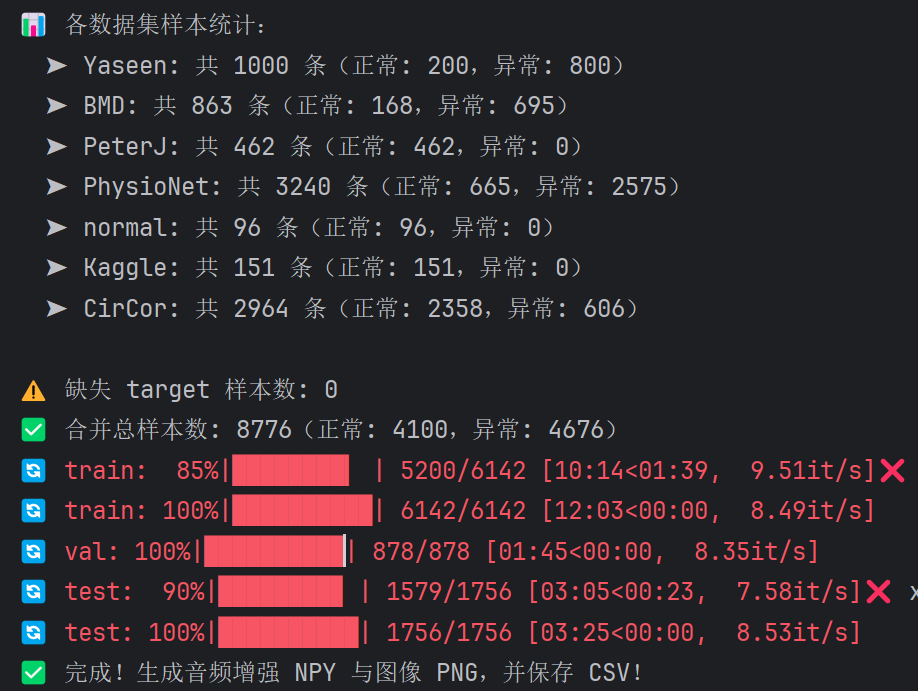
总健康心音数:4100
总患病心音数:4676
数据集统一处理
clean_data.py
统一读取7个来源的数据集,0正常,1异常
训练集:验证集:测试集 = 7:1:2
- 音频数据:
- 立体声,则仅保留一个声道;
- 重采样至16kHz;
- 带通滤波:20 ~ 400 Hz;
- 裁剪、填充至10s;
- 数据增强:
- 随机遮蔽1600点:30%;
- 加入轻微高斯噪声:30%;
- 音量随机缩放:30%;
- 保存为.npy
三通道RGB谱图:
重采样至3kHz;
随机裁剪、填充至8s,总计24000个采样点;
双谱图 —— R通道
使用现成的polycoherence工具
https://github.com/trichter/polycoherence
1
2
3
4
5
6
7
def compute_bispectrum(y, sr=1000):
    y = y[:2500]
    f1, f2, bi_spectrum = polycoherence(y, fs=sr, nfft=512, nperseg=128, noverlap=96, norm=None)
    bi_spectrum = np.log1p(np.abs(bi_spectrum))
    bi_spectrum = np.power(bi_spectrum, 0.5)
    bi_spectrum = (bi_spectrum - bi_spectrum.min()) / (bi_spectrum.max() - bi_spectrum.min() + 1e-9)
    return bi_spectrum
短时傅里叶变化(STFT) —— G通道
1
2
3
4
5
6
7
def compute_stft(y, sr=1000):
    f, t, Zxx = stft(y, fs=sr, nperseg=128)
    S = np.abs(Zxx)
    S = np.log1p(S)
    S = np.power(S, 0.7)
    S = (S - S.min()) / (S.max() - S.min() + 1e-9)
    return S
梅尔频率倒谱系数(MFCC) —— B通道
1
2
3
4
5
def compute_mfcc(y, sr=1000):
    mfcc = librosa.feature.mfcc(y=y, sr=sr, n_mfcc=40)
    mfcc = np.log1p(np.abs(mfcc))
    mfcc = (mfcc - mfcc.min()) / (mfcc.max() - mfcc.min() + 1e-9)
    return mfcc
裁剪函数
1
2
3
4
5
def crop_center(img, crop_size=128):
    h, w = img.shape
    top = max((h - crop_size) // 2, 0)
    left = max((w - crop_size) // 2, 0)
    return img[top:top + crop_size, left:left + crop_size]
将三个通道的图谱进行裁剪,随后堆叠合并为RGB图像,即为最终图像模型的训练数据,如下为例:

最终文件夹结构:
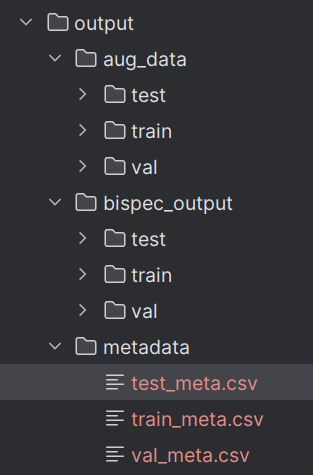
aug_data: 音频对应npy
bispec_output: RGB谱图
netadata: 图像与音频对应关系