03-数论
模运算
大数运算中的常用操作:如果一个数太大,无法直接输出,或者不需要直接输出,则可以对它取模,缩小数值再输出;
java中,如果存在负数,先按照正整数求余,然后再加上被除数的符号:
1
2
3
4
System.out.println(123 % 10);  //3
System.out.println(123 % (-10));  //3
System.out.println((-123) % 10);  //-3
System.out.println((-123) % (-10));  //-3
取模操作的性质:
加:(a+b) mod m =((a mod m)+(b modm)) mod m
减:(a-b) mod m =((a mod m) -(b mod m)) mod m
乘:(axb) mod m=((a mod m)×(b mod m)) mod m
除法不满足
快速幂、矩阵快速幂
快速幂
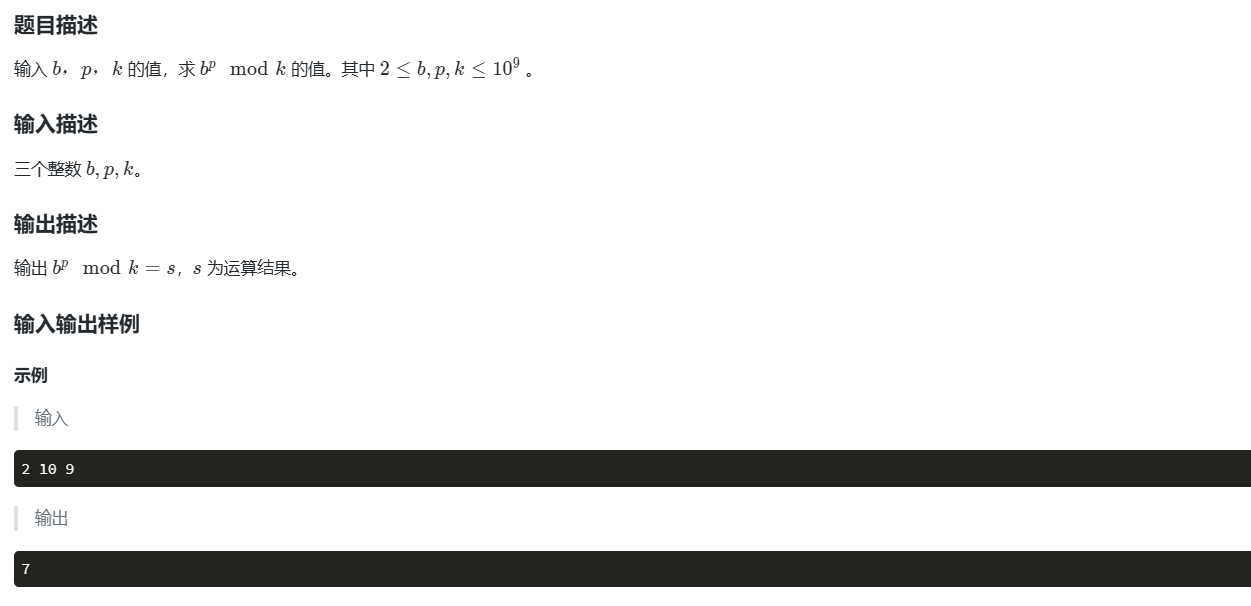
求 a n mod m,当n很大时;java直接用库函数modPow,变量用大数BigInteger
蓝桥1514
1
2
3
4
5
6
7
8
9
10
11
12
13
14
15
16
17
18
package lanQiao;

import java.math.BigInteger;
import java.util.Scanner;

public class L1514 {

	public static void main(String[] args) {
		Scanner sc = new Scanner(System.in);

		BigInteger base = sc.nextBigInteger();  // 底数
		BigInteger exponent = sc.nextBigInteger();  // 幂
		BigInteger modules = sc.nextBigInteger();  // 取模
		BigInteger result = base.modPow(exponent, modules);

		System.out.println(result);
	}
}
蓝桥1157

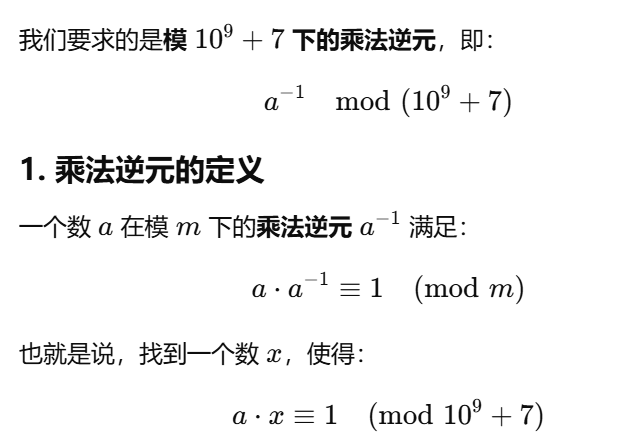
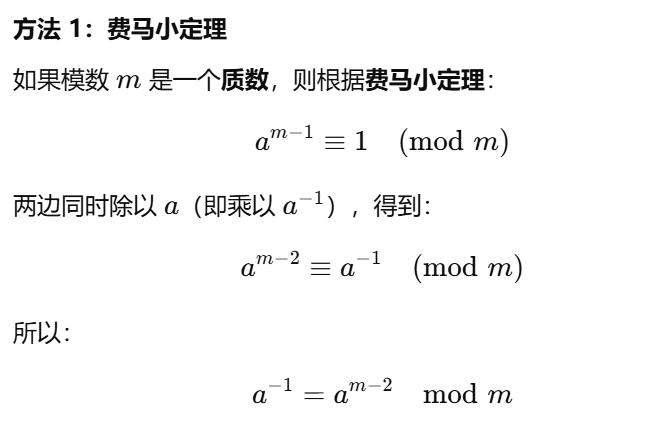
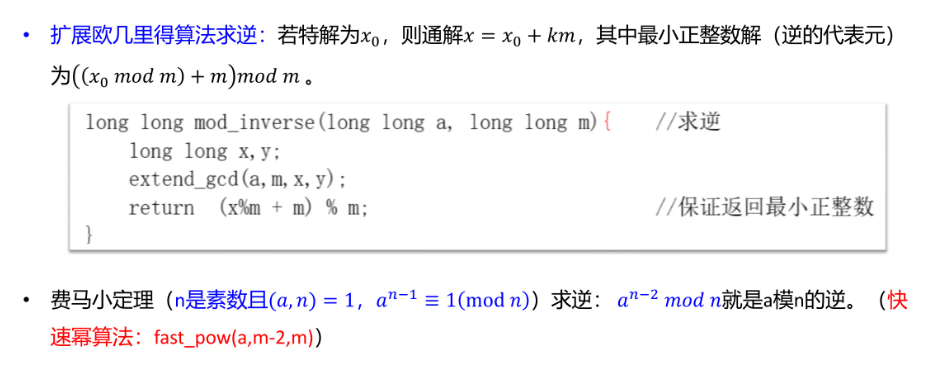
这里使用小费马定理,只能在模为质数的时候使用;
1
2
3
4
5
6
7
8
9
10
11
12
13
14
15
16
17
18
19
20
package lanQiao;

import java.math.BigInteger;
import java.util.Scanner;

public class L1157 {

	public static void main(String[] args) {
		Scanner sc = new Scanner(System.in);
		int t = sc.nextInt();
		BigInteger exponent = new BigInteger("1000000005");
		BigInteger modules = new BigInteger("1000000007");
		for (int i = 0; i < t; i++) {
			BigInteger n = sc.nextBigInteger();
            // modPow参数为两个BigInteger
			BigInteger res = n.modPow(exponent, modules);
			System.out.println(res);
		}
	}
}
蓝桥603
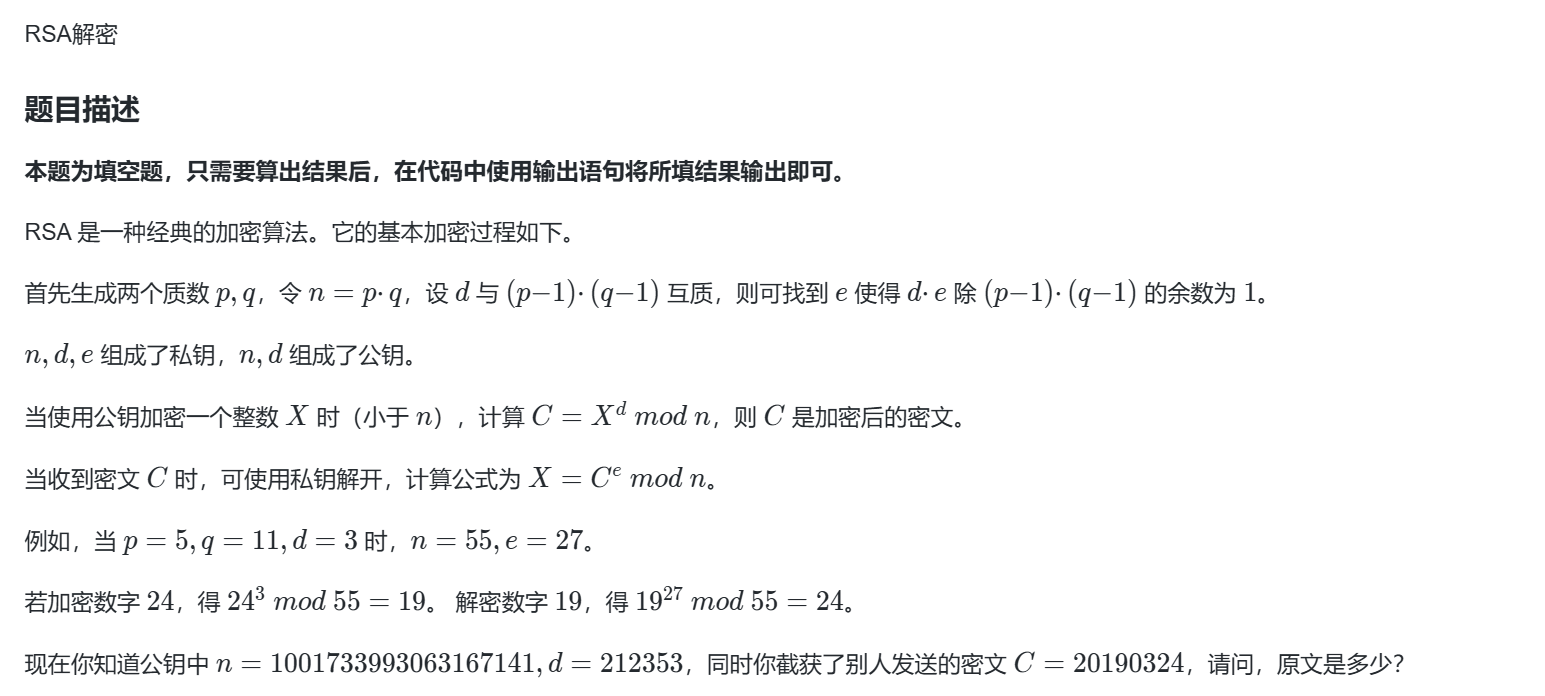
暴力计算p,q:从2到根号n,注意:BigInteger的用法
1
2
3
4
5
6
7
8
9
10
11
12
13
14
15
16
17
18
19
20
21
22
23
24
public static void main(String[] args) {
		BigInteger n = new BigInteger("1001733993063167141");
		BigInteger p = new BigInteger("2");
		BigInteger i = BigInteger.valueOf(1);
		BigInteger j = BigInteger.valueOf(0);
		BigInteger q;
		for (; p.multiply(p).compareTo(n) != 1; p = p.add(i)) {
			if (n.mod(p) == j) {
				BigInteger sep = BigInteger.valueOf(2);
				for (; sep.multiply(sep).compareTo(p) != 1; sep = sep.add(i)) {
					if (p.mod(sep) == j)
						break;
				}
				if (sep.multiply(sep).compareTo(p) == 1) {
					break;
				} else {
					continue;
				}
			}
		}
		q = n.divide(p);
		System.out.println(p + " " + q);
		System.out.println(q.multiply(p));
	} //891234941 1123984201
使用扩展欧几里得算法:
裴蜀定理:对于任意两个整数a、b,它们的最大公约数可以表示为a和b的线性组合,即存在整数x和y,使得ax + by = gcd(a,b);
本题中de % (p-1)(q -1) = 1,即有de = k(p-1)(q-1) + 1; ed - k(p-1)(q-1) = 1;
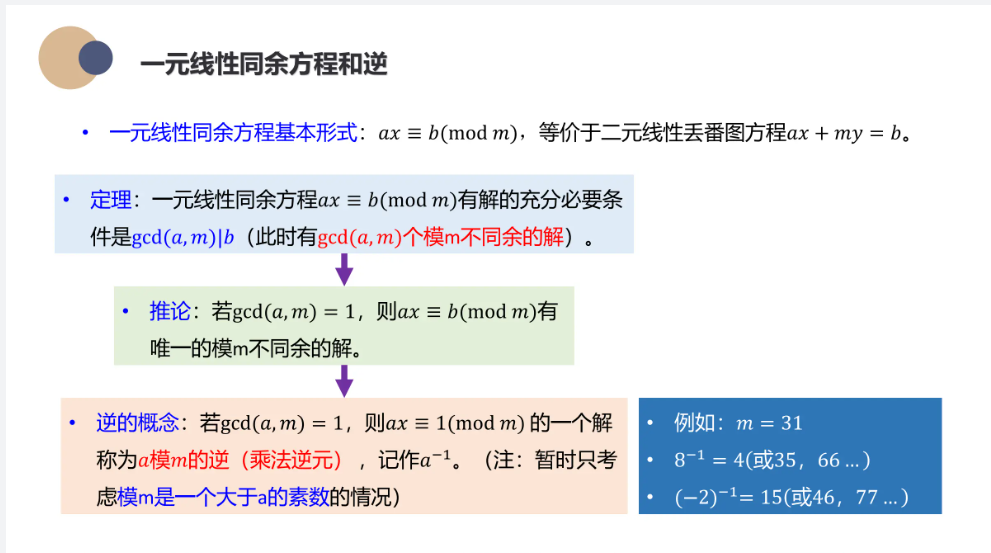
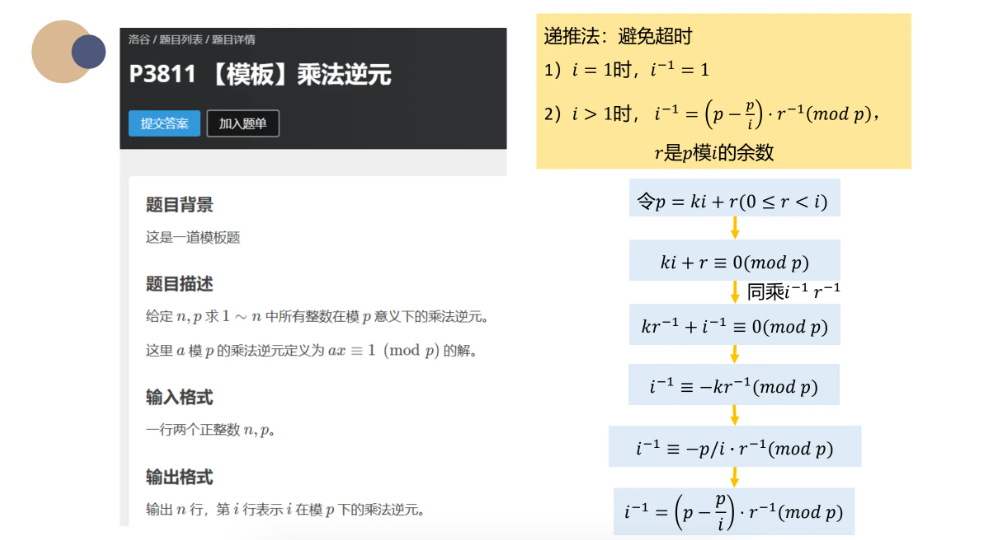
互质是逆元存在的充分必要条件
欧几里得算法,递归部分的核心如下:

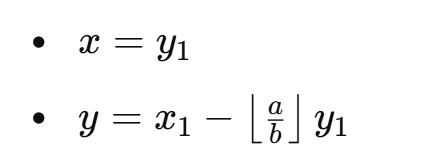
扩展欧几里得算法: 根据裴蜀定理,带入欧几里得算法变式可得:


1
2
3
4
5
6
7
8
9
10
11
12
13
14
15
16
17
18
19
20
21
22
23
24
25
26
27
28
29
30
31
32
33
34
35
36
37
38
39
40
41
42
43
44
45
46
47
package lanQiao;

import java.math.BigInteger;

public class RSAjiemi {

	// 扩展欧几里得算法,计算 a 和 b 的最大公约数,同时返回线性组合的系数 x 和 y
	public static BigInteger[] extendedGCD(BigInteger a, BigInteger b) {
		// 基本情况,当 b 为 0 时,返回 a 和 (1, 0),即 ax + by = a
		if (b.equals(BigInteger.ZERO)) {
			return new BigInteger[] { a, BigInteger.ONE, BigInteger.ZERO };
		}
		// 递归计算
		BigInteger[] result = extendedGCD(b, a.mod(b));
		BigInteger gcd = result[0];
		BigInteger x1 = result[1];
		BigInteger y1 = result[2];

		// 计算 x 和 y
		BigInteger x = y1;
		BigInteger y = x1.subtract(a.divide(b).multiply(y1));

		// gcb:a,b的最大公约数; x,y是等式ax + by = gcd(a,b)的解
		return new BigInteger[] { gcd, x, y };
	}

	public static void main(String[] args) {
		BigInteger p = new BigInteger("891234941");
		BigInteger q = new BigInteger("1123984201");
		BigInteger d = BigInteger.valueOf(212353);
		BigInteger n = new BigInteger("1001733993063167141");

		BigInteger ps = p.subtract(BigInteger.ONE);
		BigInteger qs = q.subtract(BigInteger.ONE);
		BigInteger mul = ps.multiply(qs);

		//d与(p-1)*(q-1)互质
		// 则result[1]是d在mod mul下的逆元
		BigInteger[] result = extendedGCD(d, mul);
		BigInteger gcd = result[0];
		BigInteger e = result[1];

		BigInteger c = new BigInteger("20190324");
		BigInteger res = c.modPow(e, n);
		System.out.println(res);
	}
}  // 579706994112328949
矩阵快速幂
[Fn, Fn-1, … ,Fn-k] = [Fn-1,Fn-2, … ,Fn-k-1]A = [Fk,Fk-1, … ,F0]An-k
蓝桥1180
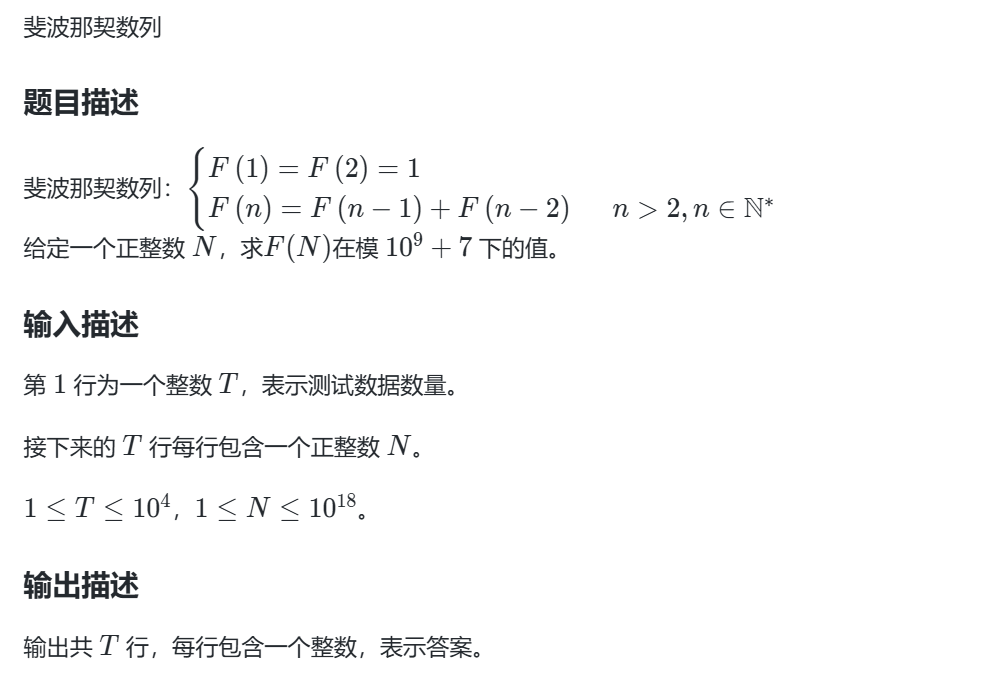
很容易手算出A值,正常使用矩阵快速幂,注意:BigInteger类型创建数组不会自动初始化为0!!
1
2
3
4
5
6
7
8
9
10
11
12
13
14
15
16
17
18
19
20
21
22
23
24
25
26
27
28
29
30
31
32
33
34
35
36
37
38
39
40
41
42
43
44
45
46
47
48
49
50
51
52
53
54
55
56
57
58
59
60
61
62
63
64
65
66
67
68
69
70
package lanQiao;

import java.math.BigInteger;
import java.util.Scanner;

public class feibonaqie {

	static final BigInteger MOD = new BigInteger("1000000007");

	public static void main(String[] args) {
		Scanner sc = new Scanner(System.in);
		int t = sc.nextInt();
		BigInteger matrix[][] = { { BigInteger.ONE, BigInteger.ONE }, { BigInteger.ONE, BigInteger.ZERO } };
		BigInteger res[][] = new BigInteger[2][2];
		BigInteger fi;
		for (int i = 0; i < t; i++) {
			BigInteger n = sc.nextBigInteger();
			BigInteger two = BigInteger.valueOf(2);
			res = matrixPower(matrix, n.subtract(two));
			fi = res[0][0].add(res[1][0]);
			System.out.println(fi.mod(MOD));
		}
	}

	public static BigInteger[][] matrixPower(BigInteger[][] matrix, BigInteger exp) {
		int size = matrix.length;
		BigInteger[][] res = new BigInteger[size][size];
		BigInteger[][] base = matrix;

		for (int i = 0; i < size; i++) {
			for (int j = 0; j < size; j++) {
				if (i == j)
					res[i][j] = BigInteger.ONE;
				else
					res[i][j] = BigInteger.ZERO;
			}
		}

		while (exp.compareTo(BigInteger.ZERO) == 1) {
			if (exp.and(BigInteger.ONE).compareTo(BigInteger.ONE) == 0) {
				res = multiplyMatrix(res, base);
			}
			base = multiplyMatrix(base, base);
			BigInteger two = BigInteger.valueOf(2);
			exp = exp.divide(two);
		}
		return res;
	}

	public static BigInteger[][] multiplyMatrix(BigInteger[][] a, BigInteger[][] b) {
		int size = a.length;
		BigInteger[][] res = new BigInteger[size][size];

		for (int i = 0; i < size; i++) {
			for (int j = 0; j < size; j++) {
				res[i][j] = BigInteger.ZERO;
			}
		}

		for (int i = 0; i < size; i++) {
			for (int j = 0; j < size; j++) {
				for (int k = 0; k < size; k++) {
					BigInteger mid = a[i][k].multiply(b[k][j]);
					res[i][j] = (res[i][j].add(mid)).mod(MOD);
				}
			}
		}
		return res;
	}
}
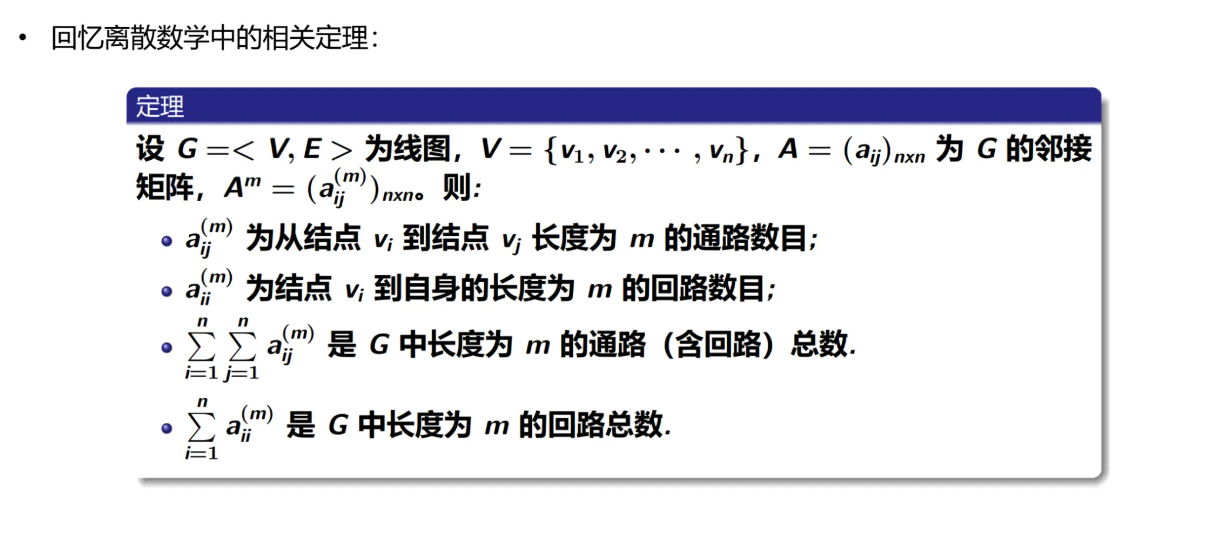
用于图论最短路径问题
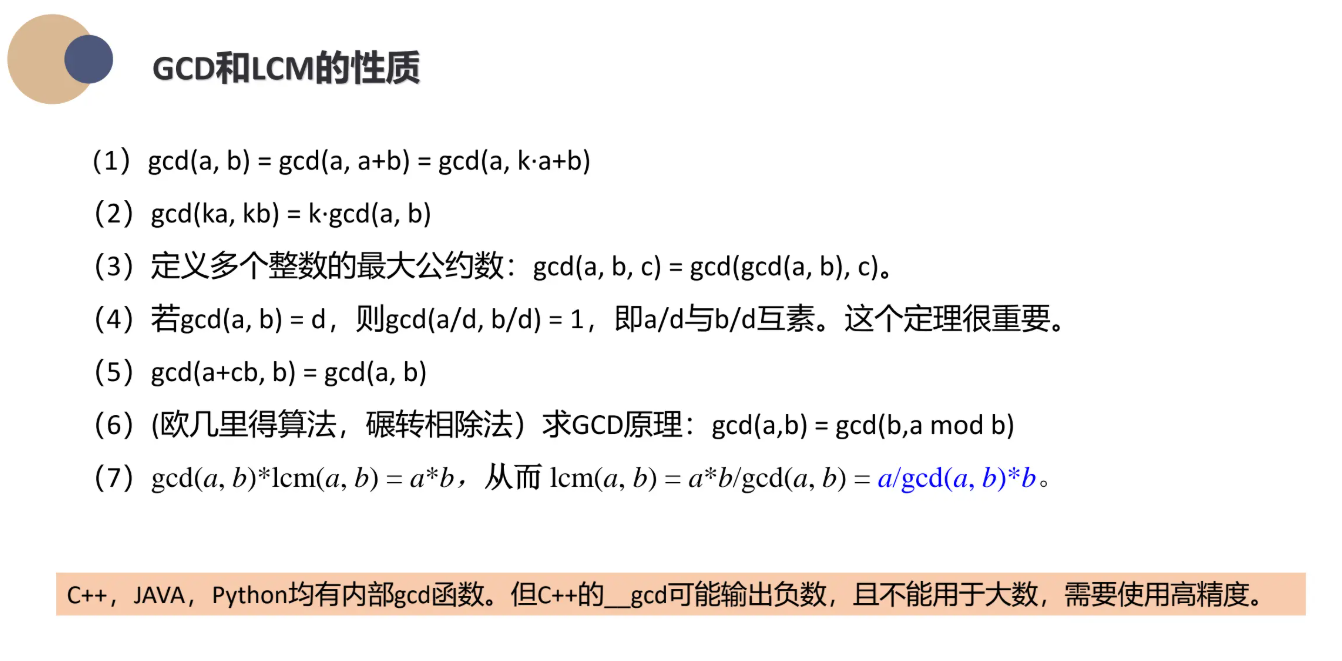
GCD和LCM
即最大公约数和最小公倍数
蓝桥210
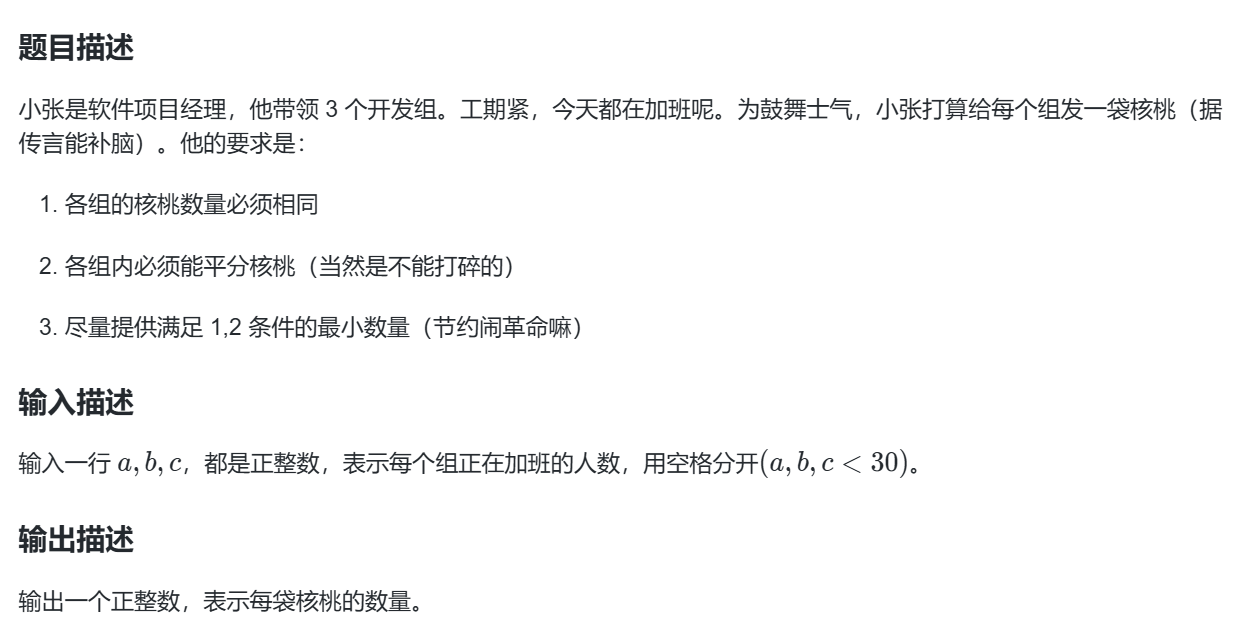
模板题, 蓝桥杯规定的java版本为8,不支持Math.gcd()
1
2
3
4
5
6
7
8
9
10
11
12
13
14
15
16
17
18
19
20
21
22
23
24
25
26
27
28
29
30
31
32
33
package lanQiao;

import java.util.Scanner;

public class hetaoCnt {

	public static void main(String[] args) {
		Scanner sc = new Scanner(System.in);
		int a, b, c;
		a = sc.nextInt();
		b = sc.nextInt();
		c = sc.nextInt();

		int minCnt = lcm(lcm(a, b), c);
		System.out.println(minCnt);
	}

	public static int gcd(int a, int b) {
		if (b == 0) {
			return a;
		} else {
			return gcd(b, a % b);
		}
	}

	public static int lcm(int a, int b) {
		if (a != 0 && b != 0) {
			return a * b / gcd(a, b);
		} else {
			return 0;
		}
	}
}
蓝桥520
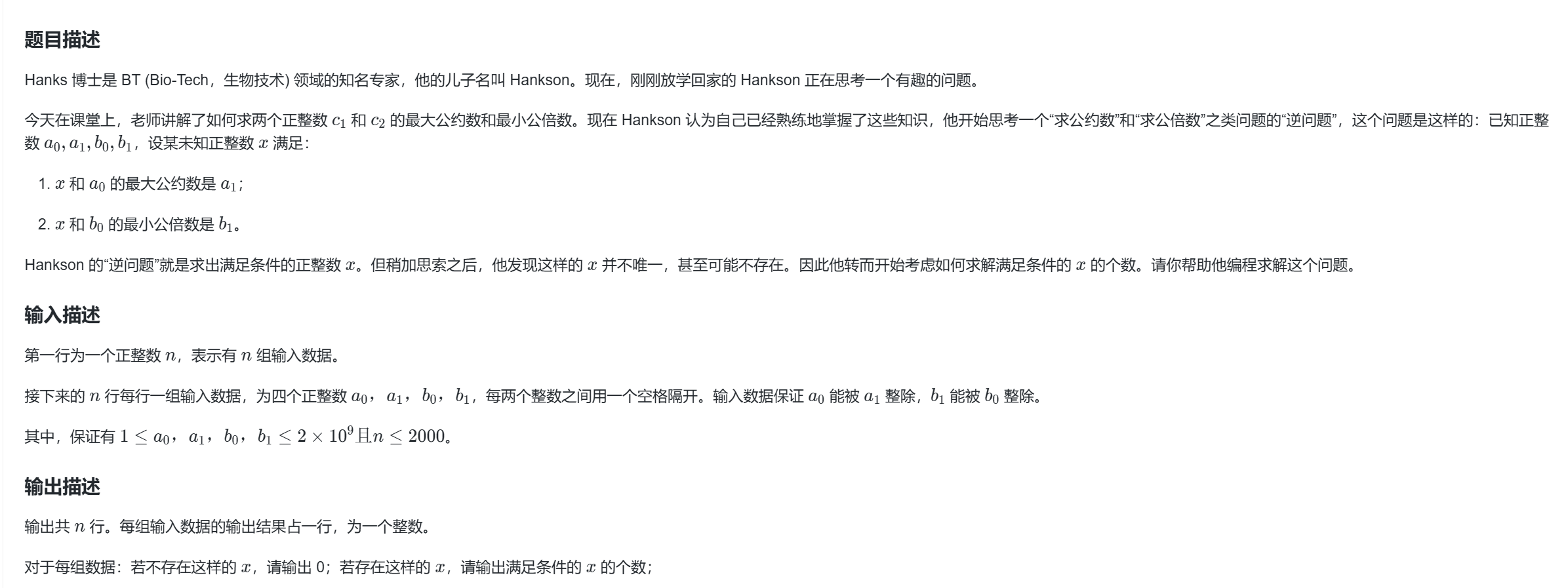
a * b /c 等同于 a / c * b,当数值较大时,先算乘法以防止溢出;
这里从根号b1的两边处理,减少扫描次数;
1
2
3
4
5
6
7
8
9
10
11
12
13
14
15
16
17
18
19
20
21
22
23
24
25
26
27
28
29
30
31
32
33
34
35
36
37
38
39
40
41
42
43
package lanQiao;

import java.util.Scanner;

public class L520 {

	public static void main(String[] args) {
		Scanner sc = new Scanner(System.in);
		int n = sc.nextInt();
		long a0, a1, b0, b1;
		for (int i = 0; i < n; i++) {
			a0 = sc.nextLong();
			a1 = sc.nextLong();
			b0 = sc.nextLong();
			b1 = sc.nextLong();
			int x;
			int res = 0;
			for (x = 1; x * x <= b1; x++) {
				if (b1 % x == 0) {
					if (gcd(x, a0) == a1 && lcm(x, b0) == b1)
						res++;
					if (x * x == b1)
						break;
					if (gcd(b1 / x, a0) == a1 && lcm(b1 / x, b0) == b1)
						res++;
				}
			}
			System.out.println(res);
		}

	}

	public static long gcd(long a, long b) {
		return b == 0 ? a : gcd(b, a % b);
	}

	public static long lcm(long a, long b) {
		if (a != 0 && b != 0)
			return a / gcd(a, b) * b;  //防止中间结果溢出
		else
			return 0;
	}
}
素数
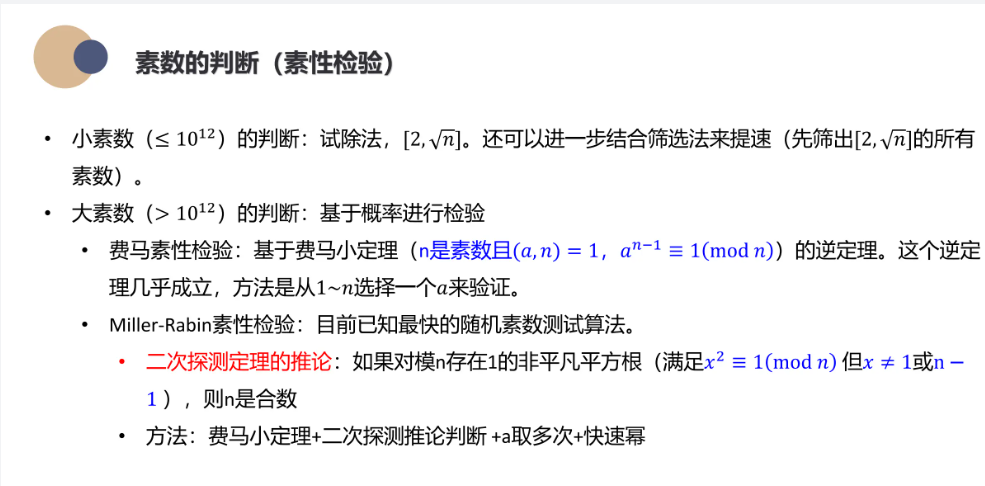
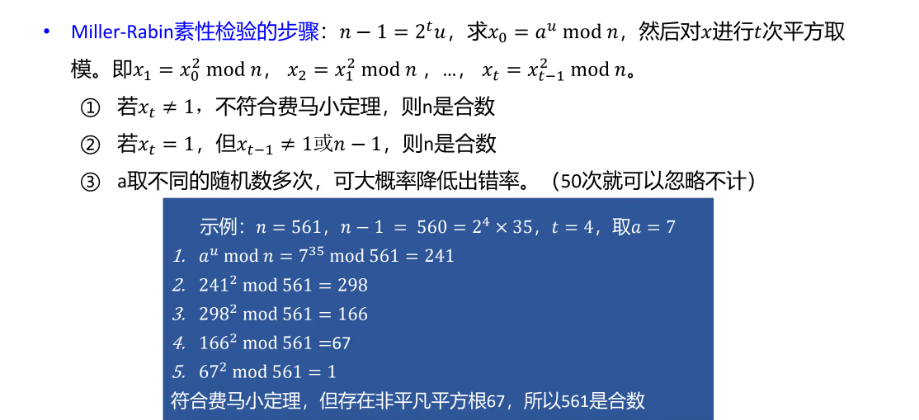
很多定理,有空再说
同余