心音疾病诊断 —— 二分类子模型训练
心音疾病诊断 —— 二分类子模型训练
1. 音频分类模型:facebook/wav2vec2-base
模型链接:https://huggingface.co/facebook/wav2vec2-base
- 不冻结任何层,修改其分类头结构如下:
1
2
3
4
5
6
7
8
9
10
11
12
13
14
15
16
17
18
19
20
21
class Wav2Vec2Classifier(nn.Module):
    def __init__(self):
        super().__init__()
        self.wav2vec2 = Wav2Vec2Model.from_pretrained("facebook/wav2vec2-base")
        self.classifier = nn.Sequential(
            nn.Linear(768, 512),
            nn.ReLU(),
            nn.BatchNorm1d(512),
            nn.Dropout(0.5),
            nn.Linear(512, 128),
            nn.ReLU(),
            nn.BatchNorm1d(128),
            nn.Dropout(0.3),
            nn.Linear(128, 1),
            nn.Sigmoid()
        )

    def forward(self, input_values):
        out = self.wav2vec2(input_values).last_hidden_state
        pooled = out.mean(dim=1)
        return self.classifier(pooled).squeeze(1)
- 损失函数:BCELoss
- 训练策略:
- 优化器:AdamW
- 学习率:主干1e-4, 分类头3.5e-4
- 学习率策略:get_cosine_shedule_with_warmup, 预热步数为20%
- batch size = 16
- 训练轮数: 5
- 保存验证集损失最低的模型
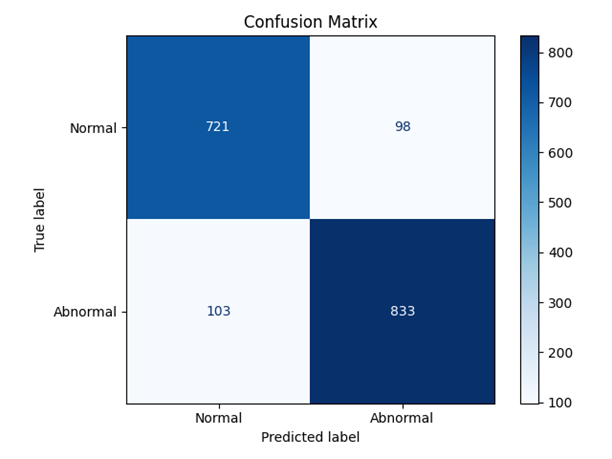
分类正确率:88.55%
2. 音频分类模型:facebook/hubert-base-ls960
模型链接:https://huggingface.co/facebook/hubert-base-ls960
不冻结任何层,同样修改其分类头结构如下:
1
2
3
4
5
6
7
8
9
10
11
12
13
14
15
16
17
18
19
20
21
class HuBERTClassifier(nn.Module):
    def __init__(self):
        super().__init__()
        self.hubert = HubertModel.from_pretrained("facebook/hubert-base-ls960")
        self.classifier = nn.Sequential(
            nn.Linear(self.hubert.config.hidden_size, 512),
            nn.ReLU(),
            nn.BatchNorm1d(512),
            nn.Dropout(0.5),
            nn.Linear(512, 128),
            nn.ReLU(),
            nn.BatchNorm1d(128),
            nn.Dropout(0.3),
            nn.Linear(128, 1),
            nn.Sigmoid()
        )

    def forward(self, x):
        out = self.hubert(x).last_hidden_state
        pooled = out.mean(dim=1)
        return self.classifier(pooled).squeeze(1)
损失函数:BCELoss
训练策略:
- 优化器:AdamW
- 学习率:主干1e-5, 分类头3.5e-4
- 学习率策略:get_cosine_schedule_with_warmup, 预热步数20%
- batch size = 16
- 训练轮数:5
- 保存验证集损失最低的模型
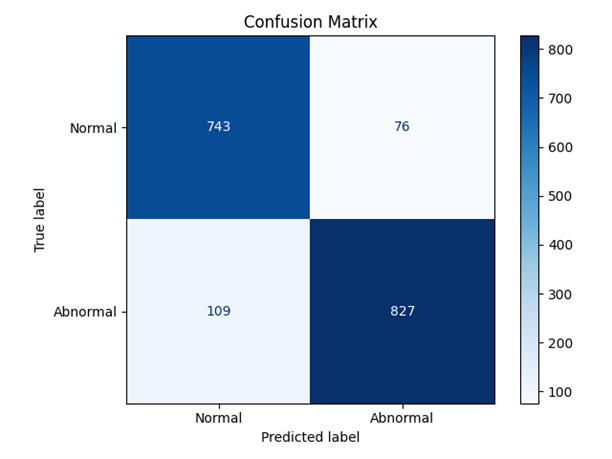
分类正确率:89.46%
3. 图像分类模型:convnext_tiny
图像数据增强处理:
1
2
3
4
5
6
7
8
9
10
train_transform = transforms.Compose([
    transforms.Resize((224, 224)),  # 统一大小
    transforms.RandomHorizontalFlip(),  # 水平方向随机翻转
    transforms.ColorJitter(brightness=0.2, contrast=0.2),  # 颜色抖动
    transforms.RandomRotation(degrees=3),  # 轻微旋转
    RandomCLANE(p=0.4, mask_ratio=0.25),  # 对图像的判别性区域进行掩码擦除
    transforms.ToTensor(),
    transforms.Normalize([0.485, 0.456, 0.406], [0.229, 0.224, 0.225]),
    transforms.RandomErasing(p=0.1)  # 随机擦除
])
调整模型输出类别为2:
1
model = create_model("convnext_tiny", pretrained=True, num_classes=NUM_CLASSES)
损失函数:带标签平滑和类别权重的交叉熵损失函数,由于在训练过程中发现健康样本比较难区分,因此提高健康样本的权重
1
criterion = nn.CrossEntropyLoss(label_smoothing=0.1, weight=torch.tensor([1.1, 0.9]).to(DEVICE))
训练策略:
- 优化器:AdamW
- 学习率:主干1e-5, 头部3.5e-4
- 学习率策略:get_cosine_schedule_with_warmup, 预热步数20%
- batch size = 64
- 训练轮数:30
- 保存验证集损失最低的模型
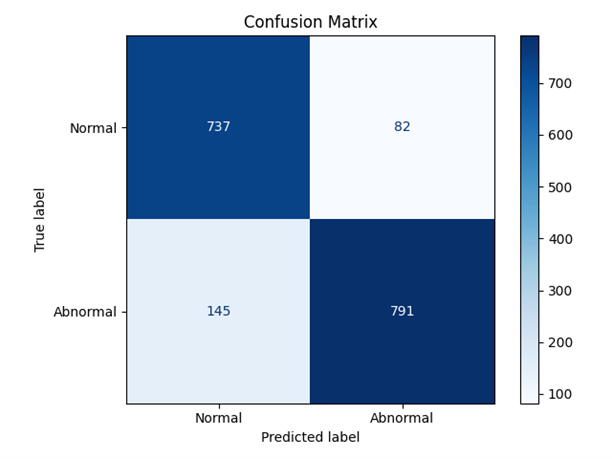
分类正确率:87.07%
This post is licensed under CC BY 4.0 by the author.